Care for what you share.
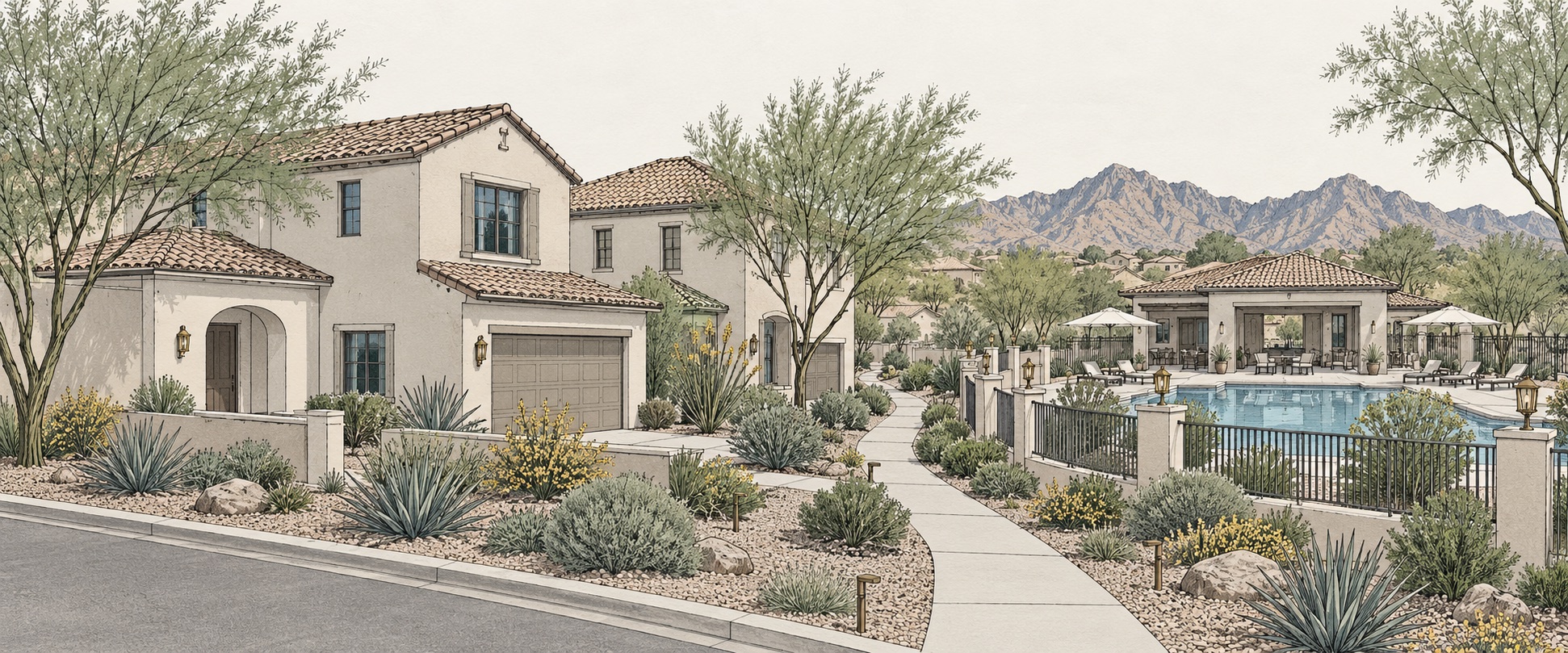
Landscaping, common areas, pools, roads, or building components may be association responsibilities.

Where your assessments go. Who makes decisions.
What to do when you need an answer.
01 / The association
It's how homeowners share the responsibility and cost of caring for their community.
Every association is different, but most HOAs exist to maintain shared property, administer the community’s governing documents, and manage expenses that benefit the neighborhood as a whole.
Your monthly or quarterly assessment allows the association to pay for these services and plan for future expenses.
Landscaping, common areas, pools, roads, or building components may be association responsibilities.
Budgets and reserve planning keep everyday expenses and future repairs in view.
Governing documents establish community standards and define responsibilities.
Depending on your community, your association may be responsible for things like:
When an association is managed well, homeowners may not notice everything happening behind the scenes — and that is often a good thing.
Common areas, landscaping, amenities, roads, roofs, and other shared assets require ongoing maintenance. A well-run HOA helps ensure these responsibilities do not get ignored until they become emergencies.
Roofs eventually need replacement. Roads eventually need resurfacing. Pools need repairs. Buildings need maintenance.
Healthy associations prepare for those costs through reserve planning instead of relying entirely on large unexpected special assessments.
Community standards help establish expectations for property maintenance, parking, architectural changes, rentals, and use of common areas.
Good enforcement should be consistent, documented, and based on the governing documents — not personal disagreements between neighbors.
Pools, clubhouses, parks, fitness centers, trails, landscaping, and other amenities are often possible because homeowners collectively fund and maintain them.
Associations frequently contract with landscapers, insurance providers, maintenance companies, contractors, attorneys, accountants, and other professionals.
A strong management company helps coordinate those relationships, monitor performance, review invoices, and keep projects moving.
Homeowners should not have to figure out which board member, vendor, or contractor to contact every time something happens.
Management provides a central place for questions, requests, payments, architectural applications, maintenance concerns, and association information.
02 / Your money
They fund the association's shared obligations: the work happening today and the repairs coming later.
Depending on the community, your assessment might help pay for landscaping, insurance, utilities, maintenance, repairs, management, legal and accounting services, amenities, reserve contributions, and dozens of other shared expenses.
We believe homeowners should have access to clear information about their association’s finances. Well-managed communities should be able to explain their budget, major expenses, reserve funding, and long-term financial plans.
Operating expenses
Reserve contributions
A roof doesn't last forever. Neither does a private road or a pool pump. Reserve funding sets money aside for major repairs and replacements before the whole bill arrives.
Know which shared components will need repair or replacement.
Set aside money over time for those future needs.
Keep upcoming work visible in the association's financial planning.
A special assessment is an additional charge outside normal recurring dues. It may still be necessary when operating funds or reserves cannot cover an expense. Approval requirements depend on your documents and applicable law.
03 / Who does what
The board governs the association. Management carries out the work under the board's direction.
Live here. Participate.
Homeowners fund shared expenses through assessments and follow the community's governing documents. Questions, maintenance reports, meeting participation, and elections help connect homeowners with their association.
Make association decisions.
Your HOA is governed by a Board of Directors, typically made up of homeowners who volunteer their time to serve the community.
The Board makes association-level decisions, approves budgets, establishes policies, enters into contracts, and oversees the management of the community.
Coordinate and follow through.
The management company works on behalf of the association and under the direction of the Board.
At Vantage, that may include homeowner support, billing, collections administration, vendor coordination, financial reporting, compliance management, meeting support, maintenance coordination, and operating the association’s homeowner portal and website.
04 / Rules & documents
Most communities have several documents that establish how the association operates. They answer different questions.
If you are ever unsure which rule applies, ask us. Homeowners should not need to become HOA attorneys just to understand their community.
05 / Common questions
For account balances, specific rules, and requests, your community's portal and governing documents are the starting point.
When you purchase property within an association, the property is generally subject to the association’s governing documents and assessment obligations.
Those assessments fund the association’s shared expenses, including maintenance, insurance, utilities, reserves, vendors, amenities, and other community obligations.
Association expenses change just like household expenses.
Insurance premiums, landscaping contracts, utilities, labor, repairs, materials, and other costs may increase over time. Boards establish budgets based on anticipated expenses and the association’s financial obligations.
A responsible association also considers future reserve needs rather than budgeting only for today’s expenses.
A reserve fund is money the association sets aside for major future repairs and replacements.
For example, a community may need to eventually replace roofs, resurface private roads, repair a pool, repaint buildings, or replace major mechanical equipment.
Instead of waiting until something fails and asking homeowners for the entire amount at once, associations can gradually save toward those future expenses.
A special assessment is an additional assessment charged outside the association’s normal recurring dues.
Special assessments may be necessary when the association faces a major expense that cannot be adequately covered by its operating budget or reserves.
The requirements for approving a special assessment depend on the association’s governing documents and applicable law.
HOA rules generally exist to establish consistent expectations for homeowners and protect shared property and community standards.
Common rules may address parking, pets, architectural modifications, rentals, landscaping, noise, property maintenance, and use of amenities.
Management does not personally create most of these rules. We help the Board administer and communicate the rules established by the association.
First, read the notice carefully.
Many compliance notices can be resolved simply by correcting the issue or contacting management with additional information.
If you believe a notice was issued in error, contact us. We would much rather review the situation and documentation than have a homeowner ignore a notice because they are frustrated or unsure what to do.
You can submit a compliance concern through your homeowner portal.
Whenever possible, provide specific information and documentation. Management will review the concern against the association’s governing documents and applicable enforcement procedures.
Keep in mind that privacy requirements may prevent us from providing details about enforcement actions involving another homeowner.
Association account information, violations, collections matters, and certain other homeowner records may be confidential.
That means management may be actively addressing an issue even though we cannot provide another resident with the details.
Possibly.
Many associations require architectural approval before exterior changes such as paint, landscaping modifications, fences, patios, solar installations, windows, doors, sheds, or other improvements.
Before beginning a project, check your community’s architectural guidelines or submit a request through the homeowner portal.
Getting approval beforehand is much easier than trying to resolve an unauthorized modification afterward.
You own your property, but property located within an HOA is generally subject to recorded covenants and other governing documents.
Those documents establish certain rights and responsibilities for both homeowners and the association.
Submit a maintenance request through your homeowner portal.
Include photos and as much information as possible. This helps us determine whether the issue is an association responsibility, homeowner responsibility, or something that requires a vendor inspection.
Contact management as early as possible.
Ignoring an outstanding balance generally makes the situation more difficult because additional fees, interest, collection expenses, or other consequences may apply depending on the association’s governing documents and applicable law.
Available options will vary by association, but early communication is always better than waiting.
Homeowner meeting rights and procedures vary depending on the community and applicable state law, but associations generally provide homeowners with opportunities to attend certain Board or membership meetings.
Your community portal or association website will typically provide meeting notices and information.
Generally, no.
The Board of Directors governs the association and exercises the authority granted under the governing documents and applicable law.
Management helps the Board implement its decisions, administer association operations, and communicate with homeowners.
The Vantage approach
If a charge, a notice, or a requirement doesn't make sense, ask. Understanding your community should be straightforward.
Living in a homeowners association comes with shared responsibilities, shared expenses, and sometimes a lot of questions.
At Vantage Community Management, we believe homeowners deserve to understand how their association works, where their assessments go, what the rules mean, and who to contact when they need help.
An HOA is ultimately a community of homeowners working together to protect and maintain the place they call home. Our role as the management company is to make that process easier — by keeping communication clear, finances organized, vendors accountable, and homeowners informed.
Whether you’ve lived in an HOA for twenty years or just purchased your first home in one, we want interacting with your association to feel straightforward.
HOAs work better when homeowners understand what is happening in their community.
If you don't understand a charge, ask us.
If you can't find a document, ask us.
If you're planning a project and aren't sure whether approval is required, ask us.
If something in the community needs attention, let us know.
Our job isn't just to manage the association. It's to make interacting with your association easier.
With Vantage, homeowners have access to straightforward communication, an easy-to-use homeowner portal, community documents, online payments, architectural requests, maintenance requests, and a management team that is actually available when you need help.